Start with a week of observation. Where does debris collect? Which surfaces need attention most often? How much of the floor remains accessible without moving chairs, shoes or cables? These answers reveal whether you need autonomous floor maintenance, a quick manual pickup tool, or a better basic cleaning kit.
Our rankings describe fit for a household job, not measured performance from a test laboratory. Advertised suction, motor power and runtime figures are useful only in context. Floor contact, brush design, sealing, navigation and the chosen power setting all influence what a cleaner actually removes.
Ranked by the work you want to reduce
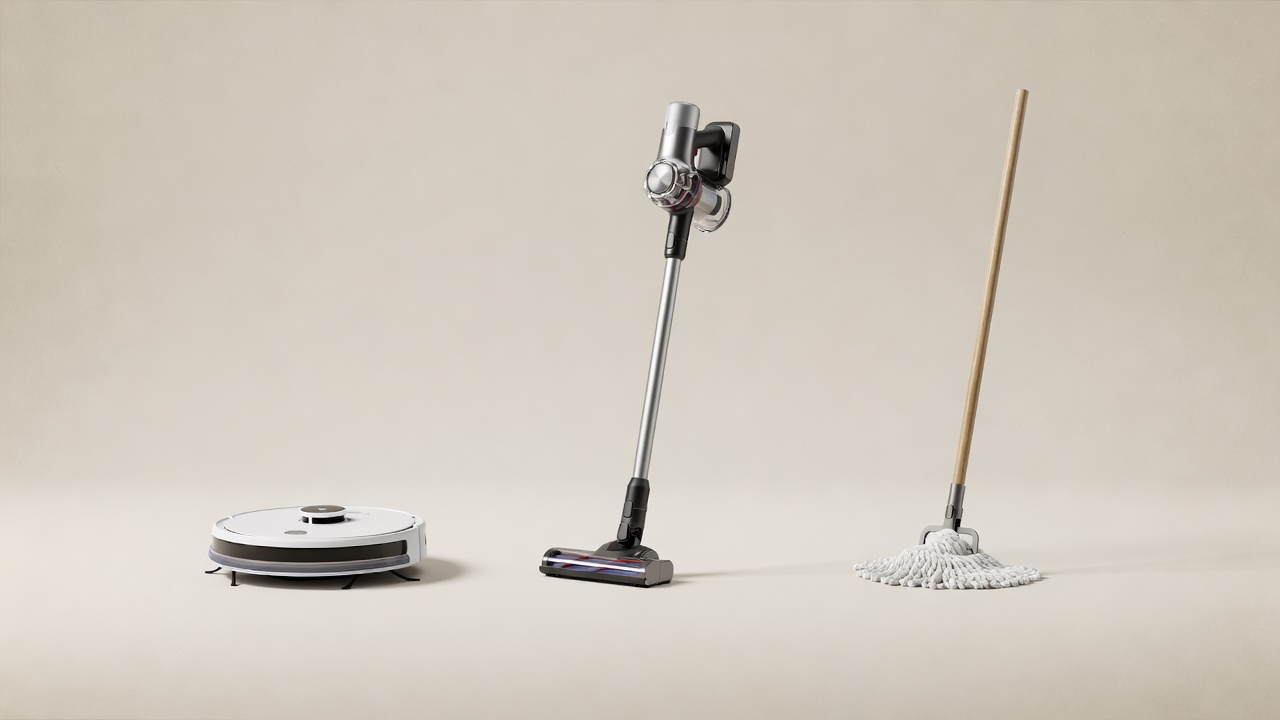
Robot vacuum for frequent, accessible-floor pickup
First choice for repetitive dust and crumbs on reasonably clear floors. Best when the home allows reliable routes and a suitable dock location. Not a replacement for stairs, upholstery or every deep-cleaning task.
Cordless vacuum for varied, short cleaning jobs
First choice when mess appears on stairs, furniture and in corners as well as on floors. Prioritize comfortable handling, useful attachments and battery support over a maximum-runtime headline.
Washable manual tools for targeted control
First choice for small spaces or tight budgets. A suitable mop, brush, squeegee and microfiber cloth can be easier to store and maintain than another powered device.
Match the tool to the floor
Hard floors, deep rugs and delicate finishes present different requirements. Check the flooring manufacturer’s care instructions before using steam, aggressive brushes or large amounts of water. A wet-cleaning robot does not make every sealed-looking surface suitable for repeated damp treatment. Older joins and damaged coatings deserve particular caution.
Measure thresholds and under-furniture clearance rather than estimating them from product photographs. Check whether the cleaner can recognize rugs, lift its cleaning pad where needed, and avoid locations that regularly cause trouble. Mapping is helpful, but the important question is whether the specific home can be cleaned without repeated intervention.
Count maintenance honestly
Every cleaner collects material that someone must eventually handle. Emptying a bin, cleaning a filter, cutting hair from a roller and washing a pad are part of ownership. An automatic emptying dock can reduce contact with dust, but adds bags, space requirements and another mechanism to maintain. A washing dock also needs attention to dirty water and residue.
Check replacement-part availability before buying. Look for the exact filter, brush, battery and bag references, not a vague promise of accessories. Consumables that are difficult to obtain can turn an otherwise functional machine into an expensive storage problem. Budget for realistic replacement intervals based on actual conditions, rather than treating every marketing interval as universal.
| Approach | Work reduced | Work retained |
|---|---|---|
| Robot vacuum | Routine floor passes | Floor preparation, stairs, brush and bin care |
| Cordless vacuum | Setup and movement between small jobs | All steering, charging and filter care |
| Manual mop and cloths | Complexity and charging requirements | Physical cleaning, laundering and drying |
Read filtration and runtime carefully
A filter label alone does not establish whole-machine dust containment. Air can escape through poorly sealed joints, and emptying technique matters. If a manufacturer cites HEPA performance, examine what was tested and under which conditions. A vacuum is not a substitute for managing a medically significant indoor-air problem with appropriate professional advice.
Runtime usually changes with power mode, floor head and surface. Compare the operating mode you would actually use, then check recharge time and whether the battery is replaceable. Standardized methods such as the IEC 62885 series can make some performance claims more meaningful, but only when the manufacturer identifies the relevant test and comparable conditions.
A robot makes sense when
- Most target floors stay accessible
- Frequent light pickup is the main job
- You can maintain brushes and the dock
A manual option may win when
- Stairs and upholstery dominate
- Clutter regularly blocks routes
- Storage or replacement-part cost is restrictive
Use a total-effort comparison
Write down weekly cleaning time before the upgrade, then estimate what remains: preparation, rescue attempts, emptying, washing and occasional deeper cleaning. The useful gain is the difference, not the number of minutes a machine moves around unattended. Noise and scheduling matter too, especially in shared spaces or homes with pets.
A lower-priced tool that is comfortable enough to use regularly can outperform a more elaborate purchase that stays in a cupboard. Convenience should be judged by your routine, not by the device category.